The age of humanoid robots is no longer science fiction. It is a business reality unfolding right now — and the companies that understand what is coming will be the ones positioned to lead when the dust settles.
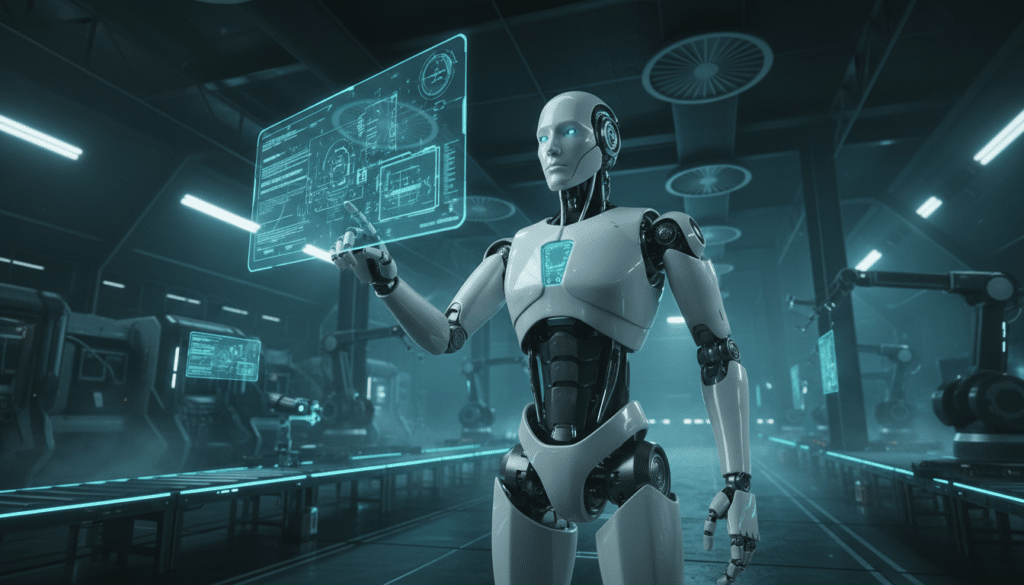
From Tesla’s Optimus to Figure’s 01, from Boston Dynamics’ Atlas to 1X Technologies’ NEO, humanoid robots powered by advanced artificial intelligence are moving out of research labs and onto factory floors, warehouses, and commercial spaces. This is not a distant disruption. It is a present-day inflection point.
What Is Actually Happening Right Now
In 2025 alone, several milestones were crossed that would have seemed implausible just five years ago. Tesla began low-volume production of Optimus robots for internal factory use. Figure AI signed a commercial deployment agreement with BMW. Amazon expanded its warehouse robotics program with bipedal units capable of navigating unstructured environments. These are not concept demos — they are live deployments with real operational KPIs.
What changed? Two things converged simultaneously: the cost of actuators and sensors dropped dramatically, and large language models gave machines the ability to reason, adapt, and follow natural language instructions. The brain and the body finally caught up to each other.
The AI Brain Behind the Machine
Earlier generations of industrial robots were powerful but brittle. They could weld the same joint ten thousand times a day, but move a bolt six inches to the left and the whole line stopped. Humanoid robots running modern AI are fundamentally different. They generalize.
Trained on massive datasets of human motion, physical interaction, and language, today’s humanoid systems can:
- Interpret verbal or written instructions in plain language
- Navigate new environments without pre-mapped paths
- Handle objects of varying size, weight, and fragility
- Learn new tasks through demonstration rather than reprogramming
- Collaborate with human workers in shared spaces without barriers or cages
This is the difference between a tool and a coworker. And it is what makes this wave of robotics categorically different from every prior wave.
Which Industries Are Being Transformed First
Not every sector will feel this equally or at the same time. The industries moving fastest are the ones with three shared characteristics: high labor intensity, repetitive physical tasks, and chronic staffing challenges.
Manufacturing and Logistics: The earliest and highest-volume deployments. Assembly, packaging, sorting, and materials handling are already being augmented and in some cases replaced by humanoid systems that work three shifts without breaks.
Healthcare and Elder Care: Patient transfer, room sanitization, supply delivery within facilities, and monitoring tasks are all early targets. The aging global population and nursing shortages make this adoption economically inevitable.
Retail and Hospitality: Inventory scanning, restocking, cleaning, and order fulfillment in back-of-house operations are being automated at scale. Consumer-facing humanoid roles are still years out, but behind the scenes the shift is already underway.
Construction: Hazardous, high-turnover, and physically demanding — construction is an industry with acute labor shortages where humanoid robots are being piloted for material transport, site inspection, and repetitive build tasks.
What This Means for Business Operations
Here is where business owners need to think carefully. The conversation around humanoid robotics often defaults to two extremes: utopian efficiency or dystopian job destruction. Neither is the full picture.
The reality is more nuanced and more strategic. Companies that deploy these systems early will gain compounding advantages in cost structure, throughput, and operational consistency. Companies that wait for the technology to be fully mature before engaging with it will be playing catch-up against competitors who have already built institutional knowledge around human-robot collaboration.
The smarter frame is not will robots replace my workforce — it is how do I redesign my operations around a mixed workforce of humans and machines, and what does that unlock?
It unlocks 24/7 capacity without overtime costs. It unlocks consistent quality without fatigue-related variance. It unlocks the ability to redeploy human workers toward higher-judgment, higher-value roles that machines cannot yet perform. And critically, it unlocks data — every interaction a humanoid robot has is logged, analyzed, and fed back into operational optimization.
The Role of AI Beyond the Physical
Humanoid robots are the most visible expression of AI’s physical expansion, but they sit within a much larger ecosystem of intelligent automation. The same AI reasoning capabilities powering robot decision-making are already being applied to customer interactions through voice AI, to revenue workflows through CRM automation, and to marketing through AI-generated content and personalization at scale.
Businesses that understand AI as a strategic layer — not just a feature to bolt on — will be the ones who integrate physical and digital automation coherently. The factory floor robot and the AI voice agent answering your phones are solving the same fundamental problem: how do you scale human capability without scaling headcount proportionally?
What You Should Be Doing Now
You do not need to deploy a humanoid robot tomorrow to benefit from what is happening in this space. But you do need to be thinking and moving in the right direction. Here is a practical starting point:
- Audit your highest-labor, most-repetitive processes. These are the first candidates for automation, robotic or otherwise. If you cannot articulate what those are, start there.
- Start with software-layer AI first. Voice AI, CRM automation, and AI-assisted operations are available now, cost-effective at any scale, and build the organizational competency to absorb more advanced automation later.
- Watch the deployment curve, not the announcement curve. Every major tech wave is preceded by years of overpromised demos. Track actual commercial deployments and unit economics, not press releases.
- Invest in workforce adaptability. The companies navigating this best are not the ones cutting people — they are the ones retraining people to work alongside and manage automated systems.
The Bottom Line
Humanoid robotics and AI are not converging on some future date. They are converging now. The timeline is compressed, the commercial interest is serious, and the underlying technology has crossed critical thresholds of reliability and adaptability that earlier generations never reached.
For business owners and operators, the window to engage thoughtfully — rather than reactively — is open today. The question is not whether AI-powered machines will reshape how work gets done. The question is whether your business will be ahead of that reshaping or behind it.
At Accurate Digital Solutions, we help businesses build the AI and automation infrastructure that positions them to scale intelligently — now and as the technology continues to advance. Schedule a consultation to explore what that looks like for your operation.