WEB DESIGN · CONVERSION
What Makes a Home Service Website Convert: The Elements That Actually Drive Calls
A lot of home service websites look professional and generate almost no leads. The site is clean, the logo is sharp, the service pages are there — and the phone barely rings. This disconnect is common, and the reasons are usually the same across businesses: design decisions that prioritize aesthetics over conversion, and missing elements that every high-performing home service site has.
Here’s what separates a site that drives calls from one that just sits there.
The Phone Number Problem
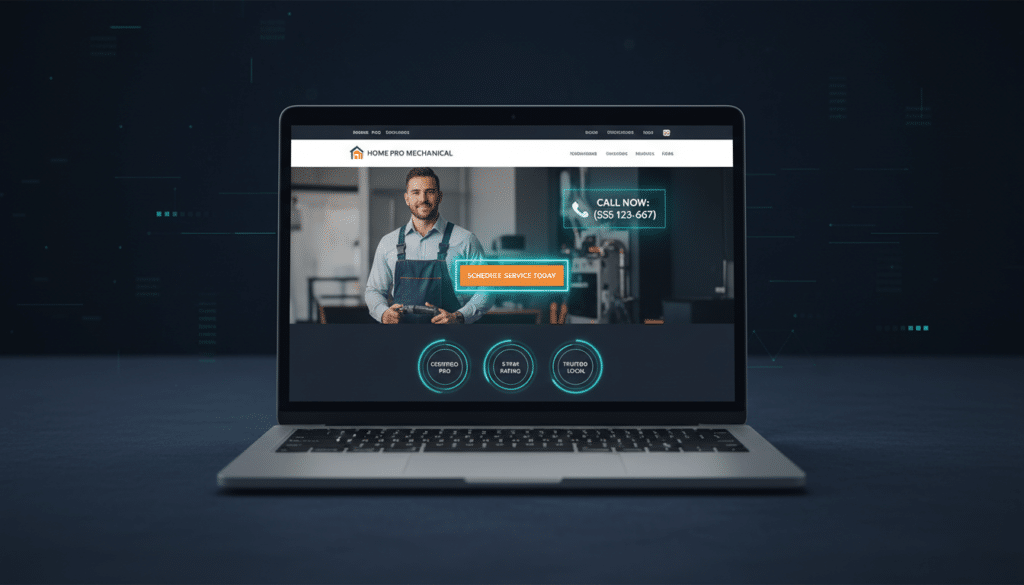
Your phone number should be visible in the top-right corner of every page, on every device, without any scrolling. This is so basic it’s almost insulting to mention — except that a shocking number of home service websites bury the phone number in the footer, require a click to reveal it, or display it in a font color that barely contrasts with the background.
On mobile, the number must be a clickable tel: link. Someone reading your site on a phone should be able to call you by tapping the number once. If they have to copy it and open a dialer manually, a significant percentage won’t bother.
Check your current site on your phone right now. Tap the phone number in the header. If it doesn’t initiate a call, you’re losing calls every day.
Trust Signals That Actually Move People
A visitor who doesn’t know your business has one question before they call: “Can I trust these people?” The answer has to be visible above the fold.
Reviews and ratings. Real reviews from real customers, displayed prominently — not buried in a testimonials page that requires three clicks. A Google review badge with your star rating near the top of the homepage converts better than any headline you’ll write.
Licenses and certifications. “Licensed, Bonded, and Insured” isn’t just a compliance statement — it’s a reassurance signal for homeowners who have been burned by unlicensed contractors. Display it early and clearly.
Years in business and local markers. “Serving Sacramento since 2010” does more trust-building work than a generic tagline. Specificity signals legitimacy.
Team photos. A photo of an actual person from your business — ideally the owner or lead technician — makes the company feel real and accountable. Generic stock photos of smiling workers in perfect uniforms signal inauthenticity to experienced buyers.
The Service Area Clarity Gap
Home service visitors have an immediate filter question: “Do they come to my area?” If a visitor can’t answer this within the first few seconds on your site, they’ll leave rather than call to find out.
Your service area should be stated clearly on your homepage — either in the headline, the subheading, or a dedicated service area section near the top. Don’t make people hunt for it.
Beyond the homepage, dedicated service area pages (one per major city or neighborhood) are one of the highest-ROI SEO investments for home service businesses. A page targeting “HVAC repair Sacramento” and a page targeting “HVAC repair Roseville” rank separately in local search and capture searches you’d otherwise miss. These pages work while you sleep.
Speed and Mobile: The Silent Conversion Killers
More than 70% of home service searches happen on mobile devices. If your site takes more than three seconds to load on a phone, you lose a significant percentage of visitors before they see anything. Google’s Core Web Vitals measure this and factor it into rankings — a slow site doesn’t just hurt conversion, it hurts visibility.
Run your site through Google’s PageSpeed Insights (free) and look at your mobile score. Scores below 50 represent significant lost conversion. Common culprits: uncompressed images, too many plugins, unoptimized fonts, and render-blocking scripts that load before the page content.
Fixing mobile speed is a technical investment, but the conversion return is immediate — faster sites get more calls from the same traffic, which effectively reduces your cost per lead without spending more on ads.
The Follow-Up System Your Site Isn’t Connected To
Most home service sites treat the website as the end of the conversion process: visitor arrives, visitor calls or fills out a form, done. But what happens to form submissions? Do they land in an email that gets checked twice a day? Are there missed calls that never get followed up on?
The highest-converting home service operations connect their website to an automated intake system: form submissions trigger an immediate text to the prospect, missed calls fire an automatic text back, and every lead lands in a CRM with a follow-up task. The website is the top of the funnel — the system behind it determines what percentage actually become jobs.
If you’re driving traffic to a site with no follow-up automation, you’re leaving a large percentage of your leads on the table — not because your site failed, but because the handoff broke down after the click.
Let’s See What Your Site Is Actually Doing
ADS builds home service websites designed to generate calls — and connects them to the automation stack that captures and follows up on every lead. If your site looks good but isn’t converting the way it should, schedule a consultation. We’ll show you exactly what’s missing and what the fix looks like.