VOICE AI · HVAC & PLUMBING
AI Receptionist vs. Answering Service: What HVAC & Plumbing Companies Need to Know
When your phone rings at 11 PM because someone’s furnace just died, what happens next determines whether you get the job — or your competitor does. Both AI receptionists and traditional answering services promise to handle calls when you’re unavailable. But they work very differently. And for HVAC and plumbing businesses dealing with unpredictable call volume, after-hours emergencies, and customers who won’t wait, those differences have real consequences.
This guide breaks down exactly what each option offers, how they compare on the things that matter most to contractors, and what to look for if you’re ready to make a change.
What Is a Traditional Answering Service?
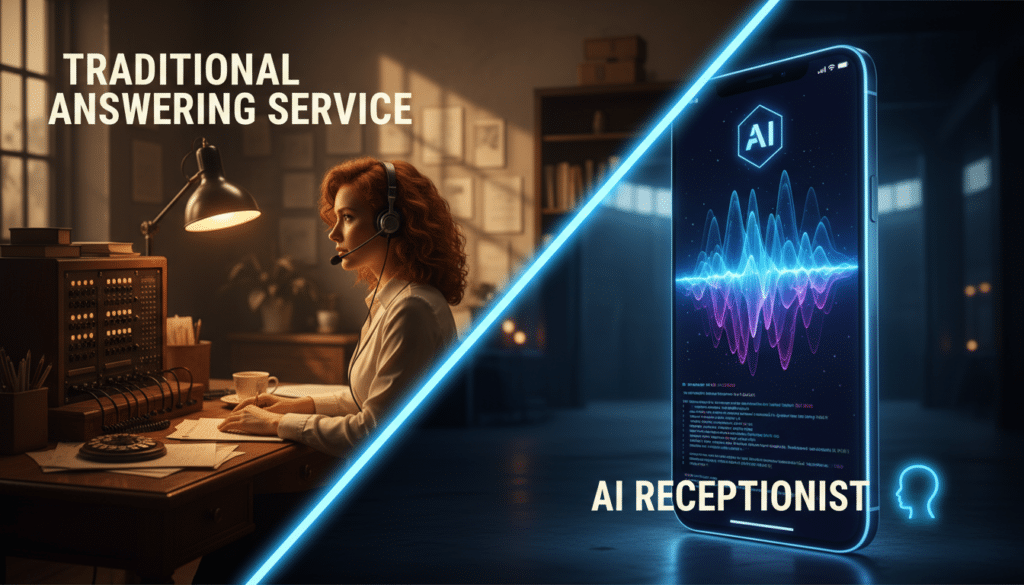
A traditional answering service connects your incoming calls to a pool of human operators — often shared across dozens or hundreds of businesses. When a customer calls and you can’t answer, the call routes to a live agent who takes a message, relays basic information, and may attempt to transfer the call.
For HVAC and plumbing companies, traditional answering services have typically offered:
- After-hours coverage with live operators
- Message taking and basic call logging
- Call transfers and on-call dispatch relay
- Scheduling information relay (not direct booking)
They’ve been around for decades and do what they promise — a real person picks up. But that model has limitations. Operators aren’t trained specifically for home service businesses. They can’t book appointments directly into your scheduling software. And because they’re shared resources, response times can slow during peak call volume. Pricing is typically per-minute or per-call, which adds up fast during busy seasons.
What Is an AI Receptionist?
An AI receptionist is a voice-powered AI agent that answers your calls automatically — but not in the robotic, press-1-for-service way you might picture. Modern AI receptionists have natural conversations. They ask the right questions, understand what callers need, and take action: booking appointments, qualifying leads, collecting contact info, and handling FAQs — all without a human operator.
For HVAC and plumbing businesses, an AI receptionist can:
- Answer every call instantly, 24/7 — no hold time, no voicemail
- Qualify the caller — service type, urgency, service area
- Book the appointment directly onto your calendar — no callback required
- Send automatic confirmation texts to the caller
- Handle after-hours emergencies — flagging urgent calls and routing correctly
- Answer common questions about pricing, service areas, and availability
The biggest difference? An AI receptionist doesn’t just take a message — it takes action. A caller who needs an AC repair at 9 PM on a Sunday doesn’t wait until Monday morning. They get booked that night.

AI Receptionist vs. Answering Service: The Key Differences
Here’s how the two options compare on the factors that matter most to HVAC and plumbing contractors:
Availability. Both offer 24/7 coverage, but AI is instantaneous. A traditional answering service may put callers on hold during high-volume periods. An AI receptionist answers on the first ring, every time, no matter how many calls come in simultaneously.
Appointment Booking. Traditional answering services can’t book directly into your scheduling software — they pass info along and your staff still has to follow up. An AI receptionist books during the call. No extra steps.
Cost Structure. Traditional services charge $0.75–$1.50 per minute or $1–$3 per call. For an HVAC company fielding 300+ calls per month, that adds up fast. AI answering services run on flat monthly subscriptions — predictable, scalable, and cheaper at volume.
Conversation Quality. Modern Voice AI holds natural conversations callers often can’t distinguish from a live person. Traditional operators read from scripts and may not know your specific services or pricing.
Integration. AI receptionists sync with scheduling software, CRM platforms, and dispatch tools. Traditional answering services operate outside your tech stack, relaying information manually with room for errors and delays.
Can an AI Receptionist Handle Emergency Calls?
This is one of the most common questions HVAC and plumbing businesses ask — and for good reason. A burst pipe or a failed furnace in January isn’t something that can wait for a morning callback.
Yes. A properly configured AI receptionist detects emergency urgency and routes it appropriately. If a caller describes water coming through their ceiling or no heat in freezing temperatures, the AI recognizes the urgency and can:
- Immediately notify the on-call technician by text
- Flag the caller for a same-night callback
- Book an emergency slot if one is available
The key is configuration. A well-set-up AI receptionist handles emergencies better than a general answering service operator — because it follows your exact emergency routing rules, every single time, without gaps.
The worst-case scenario with a traditional answering service: the on-call relay fails, the message sits until morning, and the customer calls your competitor. AI eliminates that gap entirely.

What Does an AI Answering Service Cost for HVAC and Plumbing Businesses?
Traditional answering services: $0.75–$1.50 per minute or $50–$300/month for basic plans. High call volume pushes that into the $300–$800/month range during busy seasons.
AI answering services: Flat monthly subscriptions ranging from $150–$500/month depending on features and call volume — often significantly cheaper at scale.
The ROI is straightforward. If a traditional service costs $400/month but an AI receptionist costs $297/month and captures one additional $400 job that would have been a missed call — the AI more than pays for itself.
Scalability matters too. As call volume grows, your AI handles it without additional staffing or per-call overages. You’re not penalized for being busy.
Are AI Receptionists Worth It for HVAC and Plumbing Businesses?
For most operations running under 10 technicians — yes, with one caveat: the AI needs to be properly configured for your business. A generic AI answering service won’t know your service area, pricing structure, or emergency protocols.
When it’s working right, the benefits compound:
- Every call answered — nights, weekends, holidays
- Faster booking without office staff involvement
- Consistent caller experience at any call volume
- Lower per-call cost at scale
- Emergency calls handled to your exact protocols, every time
The biggest gains go to businesses where the owner or a single office manager is the current bottleneck for answering calls and scheduling jobs. Remove that bottleneck with AI, and you can handle significantly more volume without adding overhead.
What to Look for When Choosing an AI Answering Service
Not all AI answering services are built for home service businesses. Here’s what to look for:
Industry fit. Can the AI handle HVAC and plumbing-specific questions — equipment types, seasonal urgency, dispatch protocols?
Direct calendar integration. Booking into your scheduling software during the call — not just collecting contact info.
Emergency routing. Configurable escalation rules that notify your on-call technician immediately for urgent situations.
Natural conversation quality. Listen to demo calls. Does it sound robotic outside a narrow script?
Setup and onboarding support. Is there a human team configuring the AI for your business, or are you handed a dashboard to figure out yourself?
Flat-rate pricing. Monthly subscription that doesn’t spike when you’re busiest.
Bookline Voice AI was built specifically for home service businesses — configured by our team, not left as a DIY project. Ready to see how it would work for your HVAC or plumbing operation?